
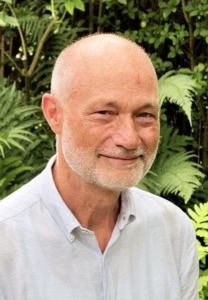
Bert Smit was born in 1956 in Surabaya, Indonesia, as the youngest of five children. At the age of two, the family moved to the Netherlands, where he grew up in Bloemendaal. After completing his secondary education at the Stedelijk Gymnasium in Haarlem, he decided to study medicine at Erasmus University in Rotterdam. As part of his training, he completed clinical rotations in Suriname, Curaçao and the south of England. After graduating as a physician, he once again spent an extended period abroad, this time during his military service with the Royal Netherlands Navy. During this period, he underwent Arctic training with the Marines in Norway and learned parachuting in Belgium.
He subsequently chose to specialize in paediatrics and worked at the Catharina Hospital in Eindhoven and the Wilhelmina Children’s Hospital in Utrecht. His subspecialization in neonatology took him to the AMC, where he worked from 1987 to 2004. In 1999, he obtained his PhD at the University of Amsterdam. From 2004 to 2010, he served as deputy head of the Neonatal Intensive Care Unit at the Sophia Children’s Hospital, part of Erasmus MC in Rotterdam.
Bert’s work in the hospital brought him into frequent contact with trauma and loss. Both acute and chronic conditions received his particular attention, including disabilities resulting from congenital and acquired brain injury, the effects of thyroid hormone on brain development, and the implementation of developmental care. He also focused on navigating medical decision-making around the end of life. In such situations, the “pink cloud” often associated with the birth of a child would frequently turn into a grey thundercloud. Supporting parents through this process has always been very close to Bert’s heart.
From patients to clients
In 2010, Bert took on a role as staff advisor at Erasmus MC, where he worked in teams analysing critical incidents in patient care until his retirement in 2023. In this staff position, he missed direct contact with patients. This, among other reasons, led him to train as a systemic and regression therapist. He later completed his training as a sexologist, which proved to be a valuable addition in supporting sexual health and addressing possible sexual concerns, both individually and within relationships.
With this, he made the transition from somatic care to mental health care, and from cure to care.
Whereas Bert previously focused primarily on treating patients and improving their physical condition, his focus has now shifted to exploring life’s deeper questions together. This coaching role suits him naturally, and he approaches his clients with gentle curiosity, exploring their motivations and resilience. Which direction do you want to move in? What are your deeper wishes? And the central question: how can you move towards self-realisation? His therapy and coaching often lead to a meaningful process of transformation.
You are allowed to become who you are
Bert: ‘Life offers opportunities to grow and develop, yet where we are on our life path, and what is needed to reach self-realisation, is often unclear. We are usually not sufficiently aware of who we truly are at our deepest level.’ Bert enjoys exploring together with the client and their environment how they can become who they truly are.
He has, of course, gone through this challenging journey himself. With two now adult daughters, a divorce after twenty years of marriage, and a transition from a heterosexual to a homosexual orientation, he has gained a wealth of life experience. He draws on this, in an appropriate way, when guiding his clients in their process of self-realisation.
Support in dealing with loss
Bert specialises in coping with loss within a family. Through his background as a medical specialist, he has built extensive expertise in experiences of loss. His medical background and his caring role as a therapist reinforce each other in this work. Loss can ultimately also lead to personal growth. Bert is committed to offering a guiding hand in such a transformative process.
